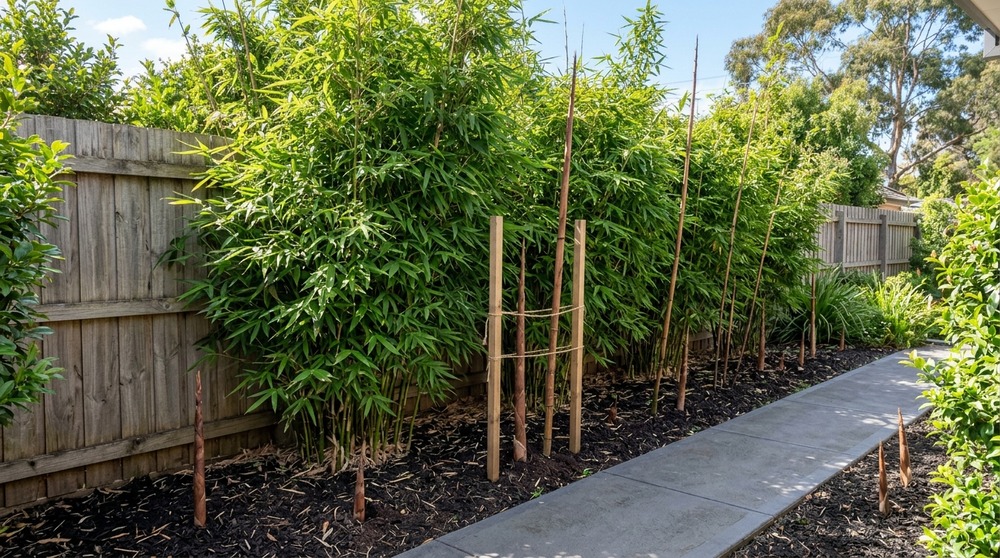
A shoot that was a fist-sized nub on Tuesday can be knee-high by Saturday. Then it keeps going. Every late spring the nursery phone picks up with people holding a photo of something that looks more like a giant asparagus spear than a plant, asking whether it’s meant to look like that. It is.
A new culm comes out at its final thickness
The diameter you see when a shoot breaks the soil is the diameter that culm keeps for life. It won’t fatten up next year, or the year after. Everything goes into height, and fast. Most culms reach full height within two to three months, before they’ve put out a single branch or leaf.
Thicker shoots each season mean the clump is getting stronger underground. If a mature plant starts sending up thin, spindly ones, something below the surface usually needs attention, often a dry root zone or a clump that’s run out of room.
Clumping bamboo pushes new culms up from the outer edge of the existing root mass rather than sending them metres away under a path, so this season’s shoots turn up close to last year’s growth. Look there first.
Leave the shoots alone, even the ugly ones
Snap the tip off a new shoot and it stops growing upward. No second attempt, no side shoot coming to the rescue. That culm stays at whatever height it reached on the day it got knocked, for as long as it lives. Usually the culprit is a dog, or a wheelie bin dragged a bit too close along the side path on a Sunday night.
Honestly? A couple of temporary stakes and some string around any shoots near a path is worth the ten minutes it takes, even if it looks fussy for a few weeks.
The papery sheaths wrapped around each shoot look untidy, and people want to peel them. Don’t. They protect the soft new tissue while it’s still growing, and they drop on their own once the culm hardens.
Water and food during the flush
A new culm is mostly water at this stage, and the plant draws harder on the root zone during shoot season than at any other point in the year. Let it dry out mid-flush and shoots stall at knee height, the sheaths go brown and that’s the end of them. November in Melbourne can throw a run of 30-degree days with very little warning, which is exactly when a newly planted clump gets caught short.
Right now, the stuff that actually matters:
- A deep soak once or twice a week through any dry stretch, rather than a light daily sprinkle that never gets past the top few centimetres
- Mulch at around 4 to 5cm, pulled back a little from the base of the culms
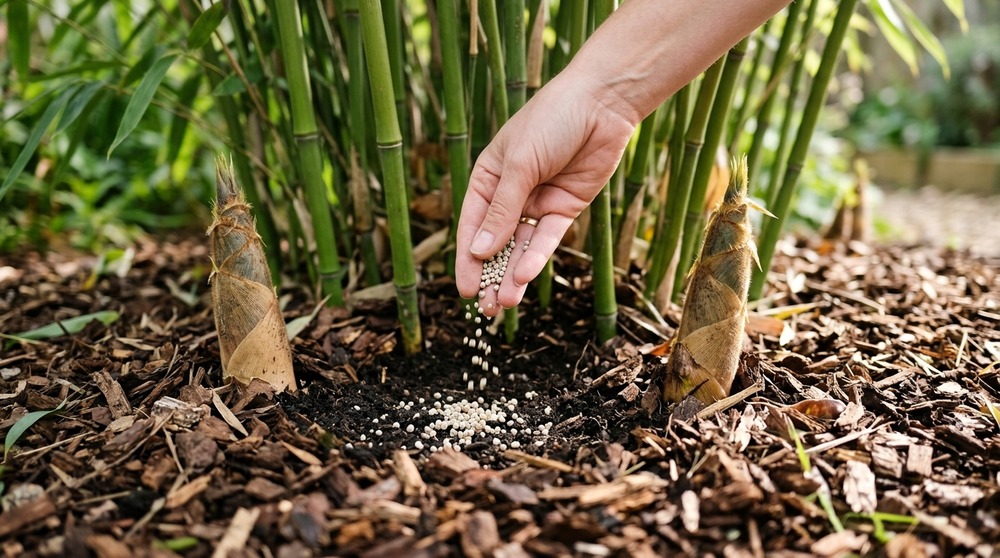
- A slow-release, nitrogen-leaning fertiliser once the first shoots show. Not before
- No digging or forking around the base. Some of the next shoots are sitting just below the surface and you won’t see them until you’ve already hit one
- Potted bamboo needs checking more often, since a container dries out far faster than a garden bed in a warm northerly
A stalled shoot and a dead one look different
Some shoots just pause. A cool week comes through, they sit there for a while, then take off again once it warms up, and nothing about them changes colour in the meantime. A dead one gives itself away. The sheath browns and goes papery right to the tip, and the base feels soft when you give it a gentle squeeze. If a fortnight goes by with no movement, it’s done. Bamboo routinely sends up more shoots than it can support and drops the weakest few, so losing two or three out of a flush isn’t a sign the plant’s in trouble.
Losing most of them is another matter.
If half the flush stalls at the same height, bring a photo, or one of the failed shoots, into the Heatherton nursery and we’ll tell you whether it’s water, food or something worth a closer look.